
Dynamic Transfers
When a generator within one Balancing Authority (e.g., a grid operator such as PJM) agrees to deliver power into another Balancing Authority, the operational control of its output can be transferred to the receiving Balancing Authority. This shift makes the generator available for dispatch by the receiving Balancing Authority. This process is known as a dynamic transfer. A generator that participates in a dynamic transfer can do so either through a Dynamic Schedule or a pseudo-tie.
Dynamic Transfer Requests
PJM will provide a copy of the results of its Electrical Distance and Market-to-Market Flowgates Tests if requested, along with related work papers, so long as it does not violate confidentiality agreements or reveal market-sensitive information.
PJM will also meet with each pseudo-tie application if requested to discuss modeling assumptions and the results of the Electrical Distance and Market-to-Market Flowgate Tests.
Contact DynamicTransferRequests@pjm.com for more information about creating or managing a dynamic transfer into or out of PJM.
Dynamic Schedule vs. Pseudo Tie
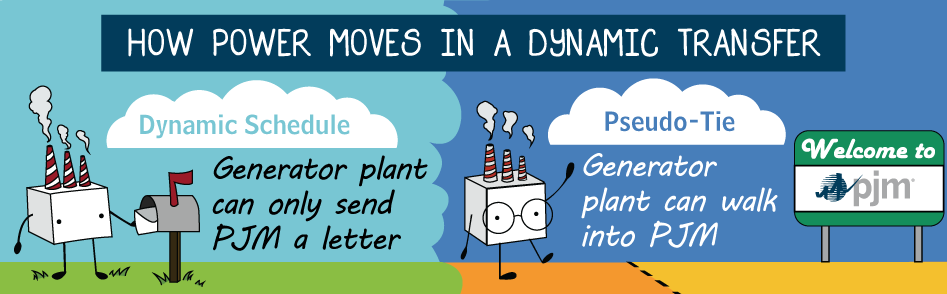
A pseudo-tie incorporates a unit physically located outside PJM into the PJM footprint for balancing and operations, while a Dynamic Schedule delivers energy into PJM but remains part of its native Balancing Authority.
Dynamic Schedule
A Dynamic Schedule is a reading or value used to schedule generation, often jointly owned, between Balancing Authorities. It is subject to North American Electric Reliability Corporation (NERC) tagging rules.
A unit may decide to Dynamically Schedule, instead of pseudo-tying, because the owner does not hold long-term firm transmission service.
Pseudo-Tie
A pseudo-tie is a reading or value used as a “virtual” connection to a grid operator when no physical tie exists. The native Balancing Authority removes the unit from its calculations to schedule generation, and the receiving Balancing Authority adds it to its own. Pseudo-ties currently are not subject to NERC tagging rules, and they must register with the North American Energy Standards Board to assist with interregional congestion management.
A unit may decide to pseudo-tie rather than dynamically schedule because the resource is seeking a capacity import limit exception in PJM’s capacity market.
Comparison of Renewable Portfolio Standards (RPS) Programs in PJM States PDF
Requirements Comparison
| Dynamic Transfer | Scheduled Interchange | ||
|---|---|---|---|
| Pseudo Tie | Dynamic Schedule | Block Schedule | |
| Cost |
Fees:
|
Fees:
|
Fees:
|
| Estimated Time to Implement | 12-30 months | 3-6 months | 1 week - 1 month |
| Capacity Market Participation | Eligible | Not Eligible | Not Eligible |
| Agreements | Pro Forma Dynamic Schedule WEB | Not Required | |
| Resource Eligibility Criteria |
|
Not Required | Not Required |
| Automatic Generation Control (AGC) Modeling | Required | Required | Not Required |
| EMS Modeling | Required | Not Required | Not Required |
| Outage Reporting | Required via eDART | Required via eDART | Not Required |
| Transmission Service Manual 12: Balancing Operations WEB | PDF Quick User Guide (PDF) |
|
|
All types permitted bases on members executed agreements per line of business |
| Day-Ahead Capacity Must Offer | Required | Not Required | Not Required |
| Telemetry | Required | Required | Not Required |
| Energy Scheduling | Telemetry | Telemetry | Block scheduling (minimum 15-minute duration) |
| PJM Membership | Required (Membership Assistant) | Required (Membership Assistant) | Required (Membership Assistant) |
| NAESB Registration | Electric Industry Registry; both Entity and Pseudo Tie Registration PDF |
Electric Industry Registry; Entity Registration | Electric Industry Registry; Entity Registration |
| NERC Tagging | Not Required | Required via third-party tag agent software | Required via third-party tag agent software |
| Unit Specific | Yes | Yes | No |
*Agreements listed on the Dynamic Transfers page are for reference only. PJM will provide official agreements for execution.